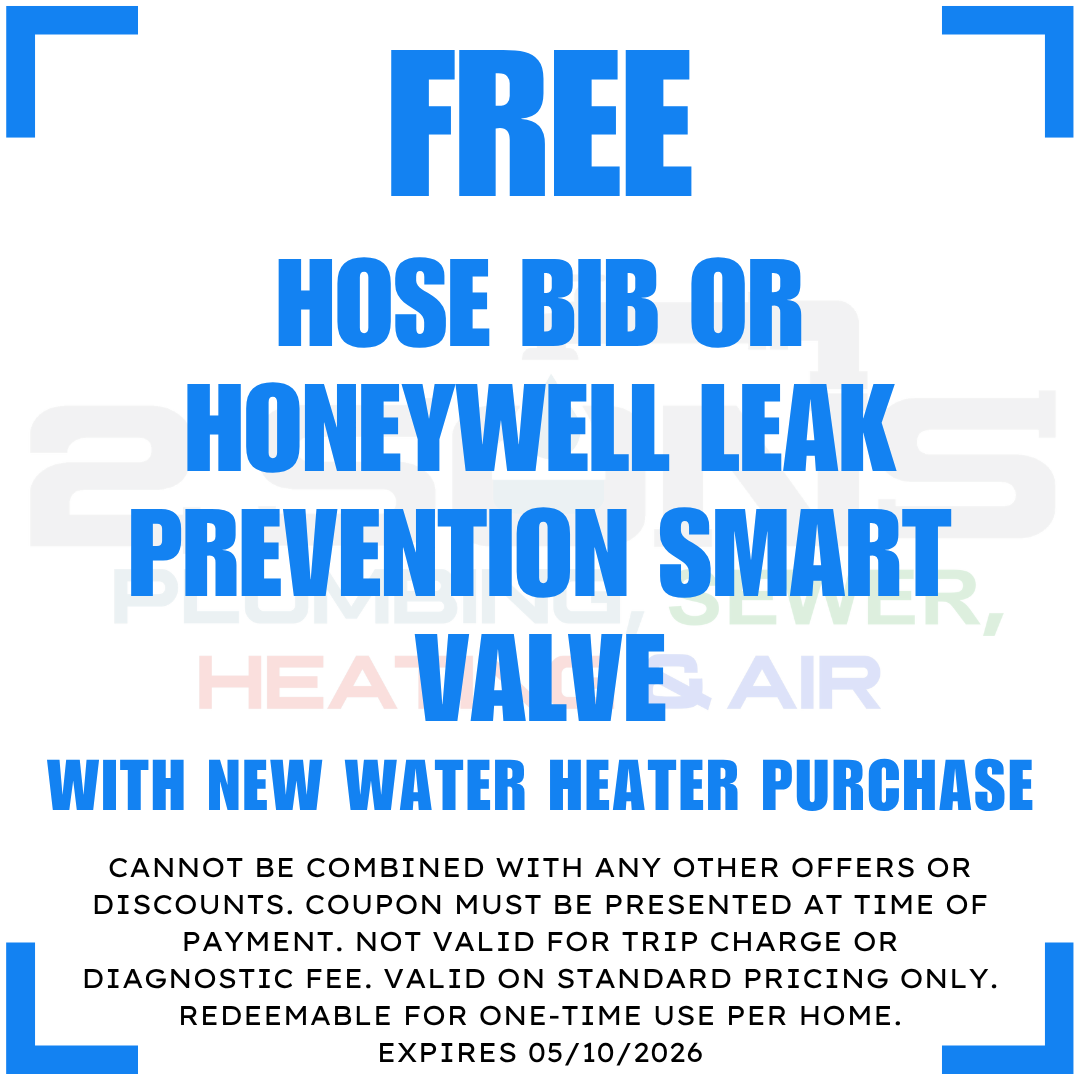
Purchase any new water heater installation from 2 Sons Plumbing and select one free add-on installed in the same visit.
Choose Your Free Add-On:
Option A — New Hose Bib Installation
A hose bib is your home's exterior water connection — the outdoor spigot used for hose connections, garden irrigation, car washing, and exterior cleaning.
Seattle's winter freeze-thaw cycle is the most common cause of hose bib damage. Water left in an exterior spigot during freezing temperatures expands inside the fitting, cracks the valve body, and causes internal leaks that often go undetected until spring. A damaged hose bib drips continuously or fails to shut off completely — wasting water and increasing your utility bill.
Spring is the standard time to assess and replace hose bibs following winter. A new frost-free hose bib installation — standard in current Seattle builds — positions the shutoff valve inside the heated envelope of the home, preventing freeze damage in future winters.
Option B — Honeywell Leak Prevention Smart Valve
The Honeywell Home Leak Detection and Smart Shutoff Valve installs on your home's main water supply line. It monitors water flow continuously and connects to the Resideo or Honeywell Home app via Wi-Fi.
When a leak sensor detects unexpected moisture — from a burst pipe, appliance failure, or slow drip behind a wall — the valve closes the main water supply automatically. The shutoff happens within seconds of detection. You receive an alert on your phone simultaneously.
Why this matters for Seattle homeowners:
Water damage from plumbing failures costs U.S. homeowners an average of $11,000 per incident according to the Insurance Information Institute. Seattle homes face elevated risk factors: older pipe infrastructure in pre-1980 builds, high annual rainfall that raises ambient moisture levels, and ground movement from seismic activity that stresses pipe connections over time.
A smart shutoff valve does not prevent pipe failures — it stops them from becoming flood events. The difference between a contained drip and a flooded basement is often the 4 to 6 hours between when a leak starts and when a homeowner notices it. The Honeywell valve closes that gap.
What your home insurance company may not have told you:
Home insurers across the U.S. are actively tightening coverage on water damage claims — and homes without leak detection systems are increasingly on the wrong side of that shift. Here is what is changing:
- Water damage is one of the leading cause of home insurance claims — surpassing fire in both frequency and total payout cost. Insurers are responding by restructuring how they handle water-related losses.
- "Preventable" water damage is being treated differently. Several major carriers now include policy language that limits or reduces payouts on water damage that occurred gradually — a slow leak behind a wall, a dripping fitting under a sink, a failing supply line — on the basis that monitoring technology could have detected and stopped it. If no detection system was in place, the claim can be reclassified as a maintenance failure rather than a sudden loss event.
- Discounts are available for homes that do have certified systems. The flip side of the same shift: insurers offer 5–15% annual premium discounts for homes equipped with automatic water shutoff valves. The Honeywell system qualifies with a number of carriers. Check your policy or call your insurer to confirm eligibility — the discount alone can offset the device cost within 1 to 2 years.
For Seattle homeowners specifically, this is not a distant industry trend. Washington State's older housing stock, high annual rainfall, and seismic activity place it squarely in the elevated-risk category that insurers are paying closest attention to. Installing a Honeywell Smart Valve now is both a protection decision and, increasingly, a financially practical one relative to what it may cost you not to have one.